

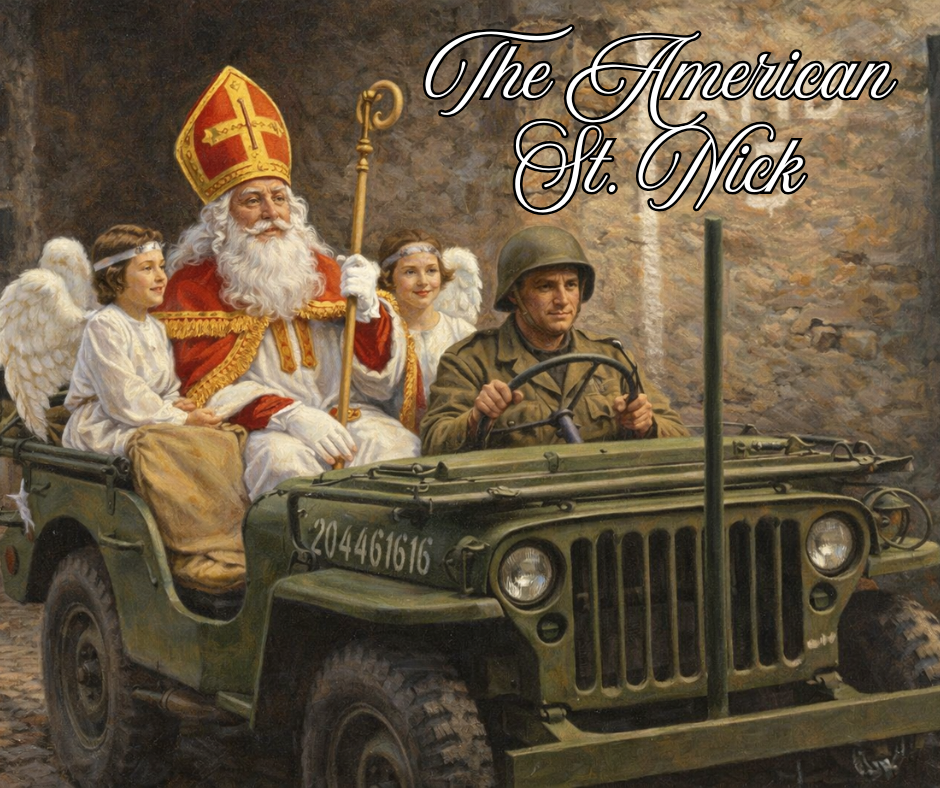
In December 1944, while much of the world clung to familiar holiday traditions despite the ongoing war, the people of Luxembourg faced yet another winter without St. Nicholas.
Before the war, St. Nicholas Day (Kleeschen) was t
he heart of the holiday season in Luxembourg. Each December 6, children polished their shoes and left them outside doors or windows, hoping St. Nicholas would fill them with sweets, nuts, apples, and small gifts. Dressed as a bishop, St. Nicholas traditionally visited towns and schools, greeting children and spreading joy and generosity throughout the season.
That tradition was stripped away during the Nazi occupation. Unlike many other occupied countries, Luxembourg was formally annexed by Nazi Germany in 1942 and subjected to forced Germanization. The French language was banned, religious freedoms were curtailed, and long-standing traditions, including St. Nicholas celebrations, were outlawed. Christmas itself was recast as a secular celebration of so-called “Germanic” heritage.
The loss of St. Nicholas Day hit children especially hard amid a war that brought fear, uncertainty, cold, and hunger and seemed to stretch on forever. Hope briefly returned in September 1944, when Allied forces liberated Luxembourg. That relief, however, was short-lived.
Just weeks later, Nazi Germany launched its final major offensive on the Western Front, the Battle of the Bulge (December 16, 1944, through January 25, 1945). The fighting tore through northern Luxembourg, with the small town of Wiltz at its center. Civilians once again found themselves under fire, sheltering in cellars as food and fuel ran dangerously low as Christmas approached.
It was there, at the height of the battle, that 28th Infantry Division soldiers, including Rochester native Corporal Richard Brookins, encountered the devastated town and learned that its children had gone years without St. Nicholas.
Corporal Harry Stutz, a Jewish American soldier, wanted to throw a Christmas party for the children of Wiltz. Town leaders noticed that Richard Brookins bore a striking resemblance to the traditional European St. Nicholas, so Corporal Stutz encouraged him to dress the part and give the children a Christmas they would remember forever.
So he did. Wearing a makeshift bishop’s robe and miter, Brookins rode through Wiltz in a military jeep, flanked by two young girls dressed as angels. His fellow soldiers chipped in the candy and gum they had. Company cooks made cookies and donuts and offered blessings at a time when the war's outcome was still uncertain.
“We weren’t much more than kids ourselves, really,” said Brookins. “It was a chance for us to have a party, too.” The weather was dark and drizzly, but spirits were bright as children – many for the first time – participated in holiday traditions that, if the war had gone another way, could have been lost forever.
The impact was profound. Amid artillery fire and destruction, Brookins’ appearance became a symbol of kindness, resilience, and humanity … a bright light in a time of unrelenting darkness. The children of Wiltz gave him a name: “The American St. Nick.” That name stuck.
After the war, Brookins returned home and eventually settled in Pittsford, where he lived quietly for many years, volunteering at the Pittsford Senior Center. Modest by nature, he rarely spoke of his wartime experience. In Luxembourg, however, his story lived on. Each year, the people of Wiltz honored both their traditional St. Nicholas and the mysterious American soldier who had brought immense joy to their children. For decades, however, no one knew the exact identity of their local hero – they only knew him as the American soldier who saved Christmas.
Brookins was finally identified in 1977 by a fellow American soldier. Upon learning their local legend was alive and well, the town of Wiltz immediately invited him to visit and, over the years, welcomed him back again and again, honoring him as a local hero and a symbol of compassion. In 2016, Brookins was awarded the Luxembourg Military Honor Medal, the country’s highest honor.
In 2015, Brookins sat down with author Peter Lion for a “Pittsford Personalities” segment on ERCN TV-12, which you can watch today. That same year, Lion published a book titled “American St. Nick: A True Story.”
Richard Brookins passed away in 2018 at the age of 96. He was buried in Pittsford’s

White Haven Memorial Park. His legacy continues through memorials, annual commemorations, and national recognition in Luxembourg. Just last year, the country issued two special stamps commemorating his act of kindness!
Why does his story endure? Perhaps because it was one of the first signs that Luxembourg’s culture would itself endure. The gifts bestowed on the children weren’t just candy; they were the hope of freedom. Freedom of tradition, identity, and the right to carry on sacred traditions.
For us at home, the story of the American St. Nicholas reminds us that our history is shaped not only by major events but also by seemingly inconsequential people whose quiet acts of kindness cross time, cultures, and nations.
 PROJECTS
 PITTSFORD
 2025 EVENT
 MEETINGS
 DOCUMENT
 TOWN
TOWN